
Brown County Court Records After Arrest
Brown County has a stronger public court-record route than jail-roster route. Official county research did not locate a public Brown County online jail roster, booking report, or inmate profile system. The court side is clearer: the Brown County Circuit Clerk page links public court-record users to Judici, lists Judici E-pay, and gives clerk contact details. The Circuit Clerk is Brooke R. Robinson. The office is listed at 200 Court St., Room 5, Mt. Sterling, IL 62353, with phone 217-773-2713 ext. 2, fax 217-773-3648, and email circuitclerk@browncoil.org.
The arrest-to-case path is separate from a jail custody lookup. For custody status, transfer questions, or booking information, use the sheriff route described on the Brown County jail inmate records page. For booking photos, use the Brown County jail mugshots page. Court records after a jail arrest focus on what the prosecutor files and what the court does with those charges, including hearings, warrants, supervision, dismissal, plea, conviction, or sentence.
The official Circuit Clerk source is shown in the captured Brown County Circuit Clerk page from the county clerk source.
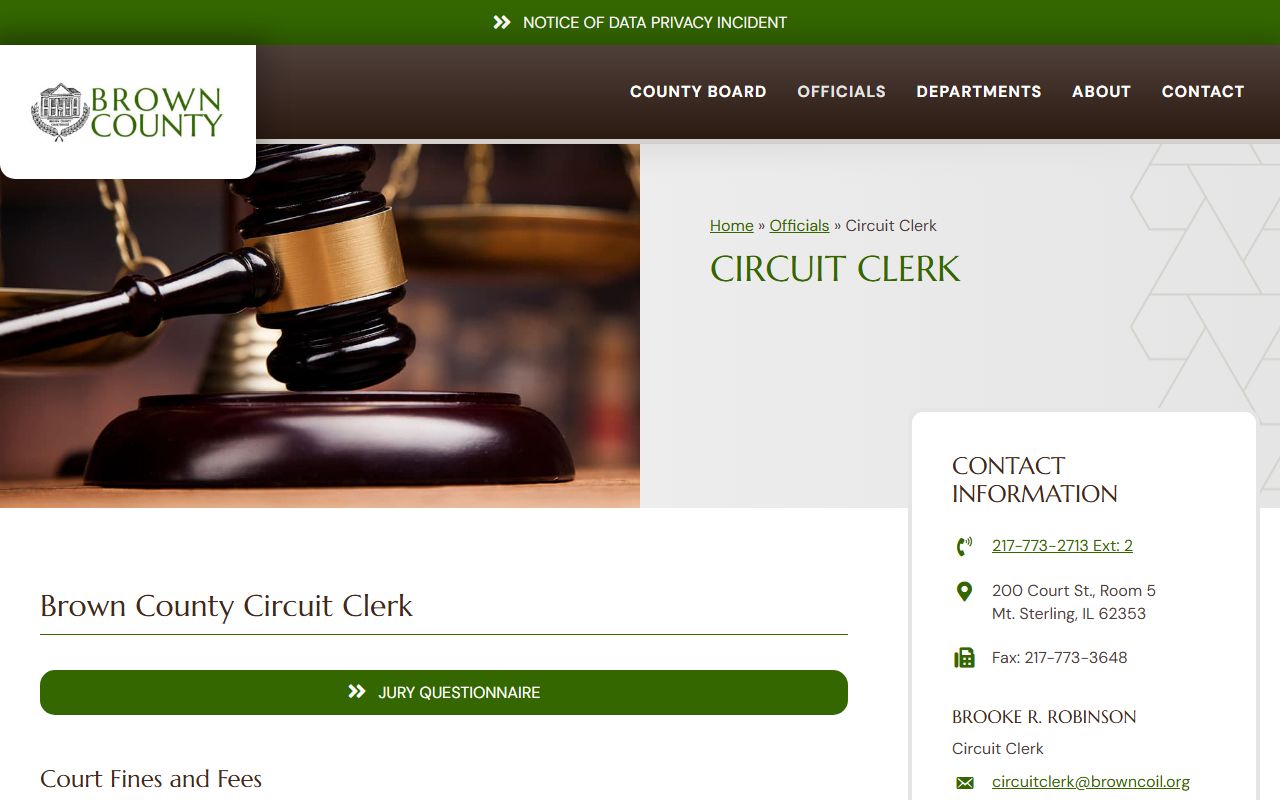
The screenshot matters because it shows Brown County's own route to public court records, while the jail roster and Judici search fields had inspection limits.
Find Brown County Arrest Court Records
After a Brown County arrest, the practical sequence is custody, first court action, prosecutor review, clerk filing, then later disposition. The Brown County Sheriff's Office can be the first stop when no case number exists. Once charges are filed, the clerk's record is the better source for the public docket, next court date, charge list, and disposition. The Illinois Courts Brown County Courthouse directory places the courthouse in District 4, Circuit 8, at 200 Court Street in Mt. Sterling, with court-building hours of 8:30 a.m. to 4:30 p.m.
- Confirm the arrest or custody status with the Brown County Sheriff's Office if the arrest is recent and no case number is known.
- Use the Circuit Clerk page's Public Court Records link to Judici after charges are filed or a case number exists.
- Search manually by the information the portal accepts. Automated Judici inspection was hCaptcha-limited, so exact field labels should be verified in the browser.
- Open the case record and compare arrest charges, prosecutor-filed charges, hearing entries, warrants, and disposition entries.
- For certified copies or a certified disposition, contact the Circuit Clerk rather than relying on a screenshot.
| Search Item | Type | Required | Brown County Note |
|---|---|---|---|
| Public Court Records | County clerk link | No | Brown County's Circuit Clerk page directs users to Judici for public court records. |
| Judici case search | Web portal | Varies | Automated inspection reached hCaptcha, so live field labels were not verified. |
| Login | Optional account link | No | Judici showed login and subscriber-service links during inspection. |
| Clerk contact | Phone, fax, email, counter | No | Use the clerk when the portal blocks access, a certified copy is needed, or a case number is known. |
Brown County directs public court-record users to Judici, but Judici access during research returned a human-verification page. That source limit is important. It supports cautious court-search guidance, not a field-by-field promise. If the portal blocks access or the case is too new to appear, call the clerk with the party name, approximate filing date, and case number if known.
Brown County Charging Documents
A jail arrest does not always match the charge that later appears in court. Booking charges can reflect the arresting agency's reason for custody. Prosecutor-filed charges reflect what the Brown County State's Attorney decides to file or pursue. The court record tracks the charge as filed, amended, dismissed, or resolved. Illinois terms vary by case type, but the three useful document labels are complaint, information, and indictment.
| Document | Who Uses It | What It Does | Brown County Caution |
|---|---|---|---|
| Complaint | Officer or prosecutor | Starts many cases with the alleged offense and facts supporting the charge. | May be close to the arrest charge, but it is still a court filing. |
| Information | State's Attorney | States the formal prosecutor-filed charge without a grand-jury indictment. | Can replace or refine the arresting agency's original charge language. |
| Indictment | Grand jury | Charges an offense through grand-jury action, usually in more serious cases. | May supersede earlier charge wording in the same court path. |
Michael Hill is listed as Brown County State's Attorney on the county source. The State's Attorney page also explains victim services and court supervision. That makes it useful for understanding the prosecutor's role, but neutral court-file copies still belong with the Circuit Clerk.
Brown County Charge Status
Charge status changes as a Brown County court record moves forward. A person can be arrested, released, held, charged, have a charge amended, receive supervision, have a charge dismissed, or be convicted. These are not the same event. A court records after arrest lookup should read the current docket entry and disposition, not just the earliest arrest language.
| Status | Meaning in the Court Record | Reader Check |
|---|---|---|
| Pending | The charge has not reached a final disposition. | Look for next hearing dates and release conditions. |
| Amended | The charge text, level, or count has changed by later filing or order. | Compare the newest entry with the first charge. |
| Dismissed | The charge was ended without a conviction on that count. | Confirm whether other counts remain open. |
| Supervision | A court-ordered disposition that can end with no conviction if conditions are met. | Brown County's prosecutor page says supervision is not available for felonies and must be ordered by the court. |
| Conviction | A guilty plea, verdict, or finding with a sentence or judgment. | Use the final disposition, not the arrest report alone. |
Release and Payment Cautions
Illinois pretrial release changed under the SAFE-T Act and Pretrial Fairness Act framework. Brown County official sources did not publish a jail bond-payment page or bonding-company procedure. The Circuit Clerk page does list Judici E-pay, a phone payment channel at 1-888-604-7888, and cash or money order over the counter, but those are court-payment channels. They should not be treated as proof that money can be posted at the jail for release in a specific case.
Payment caution: Confirm any release order, warrant hold, detainer, or court-payment instruction with the sheriff, clerk, court, or counsel before sending money.
A hold can remain even when one charge looks resolved. A bench warrant, another county warrant, parole or mandatory supervised release issue, federal hold, immigration detainer, or no-release order can keep a person in custody. For Brown County court records after arrest, the safest path is to confirm custody with the sheriff and confirm case orders with the clerk or court.
Brown County Warrants After Arrest
No official Brown County active warrant list, warrant search portal, most-wanted page, or warrant-specific phone line was found in official sources. The Brown County Sheriff IL app store listings also did not confirm a warrant lookup. A warrant can still drive a booking, cause a hold, or appear in a court record after failure to appear. Use the Brown County Sheriff's Office at 217-773-2061 for sheriff-held warrant or custody questions, then use the Circuit Clerk and Judici once a case entry exists.
An arrest warrant authorizes arrest on a new or existing charge. A bench warrant usually comes from the court, often after failure to appear or failure to follow an order. A search warrant is different because it authorizes a search of a place or property. A fugitive or other-agency warrant can create a hold even if the Brown County case is not the only case involved.
Charges and Convictions Compared
A Brown County court records after arrest search should never treat a charge as a conviction. The State's Attorney page makes the point in local terms by describing court supervision as a non-conviction disposition if ordered by the court and completed as required. A charge is an accusation. A conviction is the outcome after a plea, verdict, or finding.
| Question | Charge | Conviction |
|---|---|---|
| Stage | Accusation at booking or filing. | Final result after plea, verdict, or adjudication. |
| Who controls it | Arresting agency at booking, then prosecutor and court after filing. | Court judgment and sentencing order. |
| Can it change | Yes, it may be amended, reduced, dismissed, or replaced. | Changes usually require later court action. |
| Best source | Clerk docket and filed charging document. | Certified disposition from the Circuit Clerk. |
Sealed and Expunged Records
Some Brown County court records after arrest may not be visible in a public portal. Juvenile matters, sealed files, expunged records, sensitive law-enforcement material, and some dismissed or restricted matters can be withheld from public view. Illinois FOIA also allows redaction of private information and law-enforcement-sensitive records. Court access and FOIA access are separate, so a denial from one office does not mean every related record is public elsewhere.
| Issue | Sealed | Expunged |
|---|---|---|
| Public visibility | Restricted from ordinary public access. | Removed or treated as erased for many public-record purposes. |
| Record location | May still exist with limited access. | May be destroyed, returned, or made inaccessible under court order. |
| Common trigger | Eligible case type or court order. | Eligible arrest or disposition under Illinois clearing rules. |
| What to do | Ask the clerk what public docket, if any, can be released. | Use the court clearing process, not a private removal demand. |
Older Brown County records may require a different route. The Illinois State Archives IRAD Brown County page lists courthouse contacts and the Western Illinois University IRAD depository. For old case files, docket books, or historical indexes, ask the Circuit Clerk first and use IRAD when the clerk or archive source points there.
FOIA Limits After Arrest
5 ILCS 140/2.15 supports public access to specified arrest-report information, including identifying details, charges, arrest time and location, arresting agency, custody receipt, discharge, transfer information, and photograph when and if available. That law is useful when the request is for arrest or booking records held by a criminal justice agency. It is not a substitute for the Circuit Clerk's court file.
5 ILCS 140/3 generally requires a public body to respond to a written FOIA request within five business days unless a statutory extension applies. 5 ILCS 140/7 explains exemptions and redactions. For a Brown County court-record request, send court-file copy questions to the Circuit Clerk. For arrest or custody records, send a narrow request to the sheriff or the public body that holds the record.
Note: Broad requests can slow the process, so name the person, date, agency, case number if known, and exact record sought.